One could be pardoned for thinking that the hype surrounding the world's most cost-focussed mass produced car was all a media creation. Given not the column inches but literally double and triple page spreads in most national publications of relevance the Tata Nano was burdened with a great deal of expectation, both from within the company and outside.
The objective of delivering a four-wheeled all-metal car with performance, safety and comfort also had to keep an eye not just on the customer price point framed in 1000-point letters on the engineers walls in the ERC but also the fact that the project has to make money as well. Clearly philanthrophy was not even considered by the team led by Girish Wagh to translate his chairman's vision of providing automobility hitherto unavailable to a great strata of Indians.
Many completely rebuked the concept as not just audacious but totally harebrained when it was first espoused. This is an even more incredulous lot today, changing its line of detraction and seeking to know how and where the cost savings were made to arrive at the price Ratan Tata promised years ago. And it looks all set to deliver from the third quarter of this year.
Clever design, intelligent solutions with simplicity thrown in to achieve the functional aspects, weight reduction by way of ample digital analysis and a strict adherence to cost were some of the means employed to get the project so clearly defined through each and every stage of the design and development process.
Wagh's team underpinned its efforts by zeroing in on three vital parameters: it had to be a low cost focused automobile. Secondly it had to be designed and developed to meet all statutory safety and emission legislation while also being package protected to meet additional safety and other legislation issues which changing homologation requirements could throw at it. And finally the car had to have acceptable performance.
Clearly the project was much too daunting to have even precluded the normally focused Japanese small car giants to cry off. It also eliminated the Chinese for this was an all-new out-of-the-box concept which hadn't been made before and therefore couldn't be copied. The Europeans were scared after the painful exercise with the Smart which lost out on the grounds of complexity and price all that it tried to gain by having a very small footprint on the road. This fact was not lost on the Tata design and engineering teams and so began the arduous process of not just lateral thinking but also involving almost everyone within the company to think collectively.
Yes collective thinking came to the fore given the project's attraction. The challenge was also the attraction, engulfing everyone from the man at the helm of affairs to the shop floor operator who could - and were empowered to - bring in their own knowledge and experience to bear on various aspects of the design and engineering, the latter focusing on both the product as well as the manufacturing processes. This collective thought process was perhaps the biggest money saver and the largest repository of common sense brought to bear on a car everyone wanted to play a role in creating.
Good design was the critical element behind making effective savings in material usage, reducing mass and weight, getting the weight distribution spot-on for both ride and handling plus also stability and safety. Good design also made the engineers opt for the rear engine placement, in the process gaining both large occupant space and also major cost savings. First off lets factor in the design vis--vis the monocoque chassis. Absolute structural stiffness analysis was done concurrently with the stylists at the I.De.A. Institute in Italy who penned the look of the car.
NVH characteristics were as important to tackle at this stage as was the torsionsal strength of the structure. Using very lean but intelligent design, the team did enough to achieve its objective of a robust build for the application intended while yet not falling prey to the downward spiral of either over-designing or over-engineering. I think this is an abject lesson of great value engineering over both under - as well as over-engineering a concept.
Given the rear engineered layout, the engineers were able to move the firewall well forward and this proved advantageous in terms of not just reduced weight but also enhancing the cabin footwell area. A great deal of digital validation occurred at every stage of the design and build process, ensuring that corrective measures if needed, could be taken quickly in the normal process. Two clear instances of low weight and low material requirements come to mind straightaway: the ribbed (or swaged) roof structure is not just a style element but also a strength structure by design using sheet metal of a thinner gauge. A second design detail which delivered cost and weight reduction along with the adoption of a cheaper manufacturing process was in the use of the rear glass windscreen bonded to the tailgate. This helped in maintaining the structural rigidity while cutting down on the weight and also in the stamping and blanking processes.
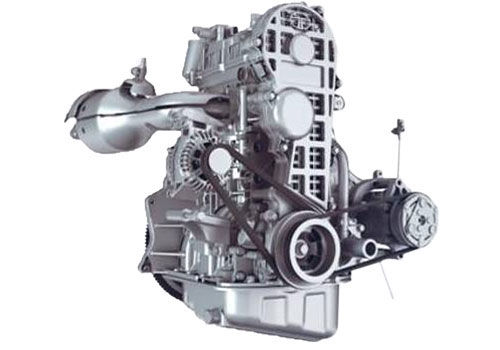
The adoption of good design and packaging of the mechanical aggregates brought in great savings. The compact manner in which the engine is configured with a transverse twin-cylinder layout placed ahead of the rear axle line with the four-speed transaxle immediately behind it aided mightily in weight distribution plus also deriving a low centre of gravity. The battery being placed under the driver's seat helped spread the weight optimally while the radiator placed at the rear on the right hand side, ensured good placement of the ancillaries from an ease of operation point of view.
The rear-engined layout also helped save costs and complexity given that the driveshafts didn't need complex joints as in a front engined, front-wheel drive car wherein these shafts also needed to swivel with the steering. GKN came up with a great set of driveshafts which are robust yet light and pretty efficient to handle the power and torque. Speaking of engine performance, the 623.6cc engine makes 33bhp at 5000rpm coupled to a lusty 48 Nm of torque at 2500rpm. In fact the commuter nature of the car is best shown on the torque front with the low engine speed peak torque is produced, staying in a linear line all the way to the upper ends of the rev range.
Driveability isn't compromised while effecting major gains in fuel efficiency. Bosch played a major role in the development of the multi-point fuelling system and also the electronic management system enabling consistent and precise fuel delivery with optimized spark control, resulting in the frugal consumption of the 623.6cc engine.
Another element of good design and engineering concerned the 623.6cc engine displacement. Earlier a 580cc engine was designed but Ratan Tata himself found this inadequate in driveability and fuel efficiency. Bumping up the displacement helped the volumetric efficiency and with good thermodynamics, achieved the engine performance characteristics to haul four adults easily in the cut and thrust of our daily commute.
Another area where critical weight was saved, both physically and also dynamically concerned the adoption of the tubeless tyres made by MRF who are the single source tyre supplier's for the Nano. Given the lack of a tube in each wheel, a total of two kilogrammes were saved from the tyres alone, the lack of mass manifesting itself in low unsprung weight and resultant benefits in dynamic ability.
The use of just the right amount of plastics for the given surface area they covered in the cabin plus the architecture of the seats with optimised cushioning are details which might not seem very glamourous but they did aid the packaging engineers in their battle to balance costs, comfort and complexity. Bare basic instrumentation for this class of car comes across as more than adequate.
Finally, the complete project cost for the Nano, from design, development and production engineering a facility to make 250,000 units per annum are pegged at Rs 1700 crores - exactly the same amount the company spent a decade ago to kick start the Indica project. If that isn't good value engineering, pray tell us what is, for a car that you can buy for the price of top notch TAG Heuer sports watch? Need of the hour or a sign of the times? Or maybe both - the clock is now ticking for all the others to try and get their Nano clones ready.
Read more...